“Those who love peace must learn to organize as effectively as those who love war.”
Martin Luther King, Jr.
Lately, it feels as though the world moves equally fast and slow.
Less time spent commuting to work.
More time spent baking something delicious.
Less time spent with friends.
More time spent with oneself.
From my last post in January to today, the world has seemed to change overnight. Shifting from business as usual to one filled with fear, COVID, social uprisings and many other events in between.
Through this global pandemic, people have slowed down their lives, found stillness in staying in. I think for many of us, this time has further revealed both the good and bad that exist in our world and in ourselves. The resurgence of agency taken by social justice groups has inspired millions to act, whether digitally or in person. Through it all, I’ve noticed the common theme of self-education, education reform and the amplification of multi-sided stories.
I’ve had this post brewing for weeks but now I see the need for it more than ever. Because if we are serious about making the changes we hope to see in the world, then it will take a lot of work, time and dedication on our part.
While America’s public education system has become more democratized, it has also become more generic. The one-size-fits-all structure is geared towards a particular type of student and generally describes a one-sided account of history and the arts. Many schools tend to focus on taking tests to get into universities to graduate, to (hopefully) get a job to pay off student loans and eventually fall into the “comfort” of a capitalist society where one works till retirement ending with a gentle slide into oblivion. This is a goal-oriented agenda and it works fine for many people but doesn’t necessarily teach us the most important skill of all – the ability to think for oneself.
Some consider graduation from high school or college a respite from having to learn, from the chore of using our brain to think and the growth and development of our own ideas and beliefs.This system and these ways of thinking are outdated and due for a new chapter.
Despite living in this “Age of Information”, we inhabit a world fraught with misinformation and the quest for truth seems more difficult than ever. In order to fight against the injustices of a racist system, corporate greed and the powers that be, we must continue to actively search for truth. To actively weed out bigoted deceit and trolling behaviors from the information we are fed through our social media channels, recognizing the origin of the algorithms that bring us this content in the first place.
So, how exactly does one become educated in a meaningful way in this day and age?
With so many learning resources available to us through the Internet (Books, Skillshare, Khan Academy, YouTube & many more!), there is no excuse for getting in some sort of learning throughout the year even if it just means reading one good book. Regardless of where we are in our lives, we can all take time to learn, whether it be an hour a day or an hour a month, it’s all about not losing momentum and recognizing balance.
I’ve been eager to learn post-college but have struggled to figure out a way to make it possible. There are so many topics and avenues to go down, making the whole process overwhelming. I sought to resist my usual temptation of quickly going from one topic to another and, instead, decided to deep dive into a few particular topics. Therefore, I have decided to build out my own curriculum based on my experience taking college classes and the research methods I learned during that time. I decided to rely on the teaching methods that I found most useful in my undergrad experience- a blend of structured and unstructured learning experiences. And, while I won’t have the opportunity to discuss with a class, I am curious to seek out scholars and online forums to supplement my journey.
For this “quarter” (June through September), I will engage in three classes of my own creation, those are:
- Procreate: Basics & Beyond
- A Brief History of Knitting
- Cottons & Quilts: A Dive into Early African American Textiles
For each class, I have taken some time to research relevant reading material and articles to sprinkle in between readings. While reading, I am careful to be objective of the author’s background and knowledge, being mindful of any biases or potential inaccuracies. I also made loose guidelines for assignments. As this is my first attempt, I plan to adjust these as needed throughout the course of my learning journey. Here’s an example of my rough guidelines:
CLASS #1 – Procreate: Basics & Beyond
- Skillshare classes – Complete ~2 classes per week from June-August
- Practice drawing on iPad at least 5 times/week
- Weekly Sketch on Tides & Textile IG account
- Monthly projects (varies) – a medium size, finished piece due at the end of each month
- FINAL – a larger sized printable piece, due at the end of September
CLASS #2 – A Brief History of Knitting
TEXTBOOKS-
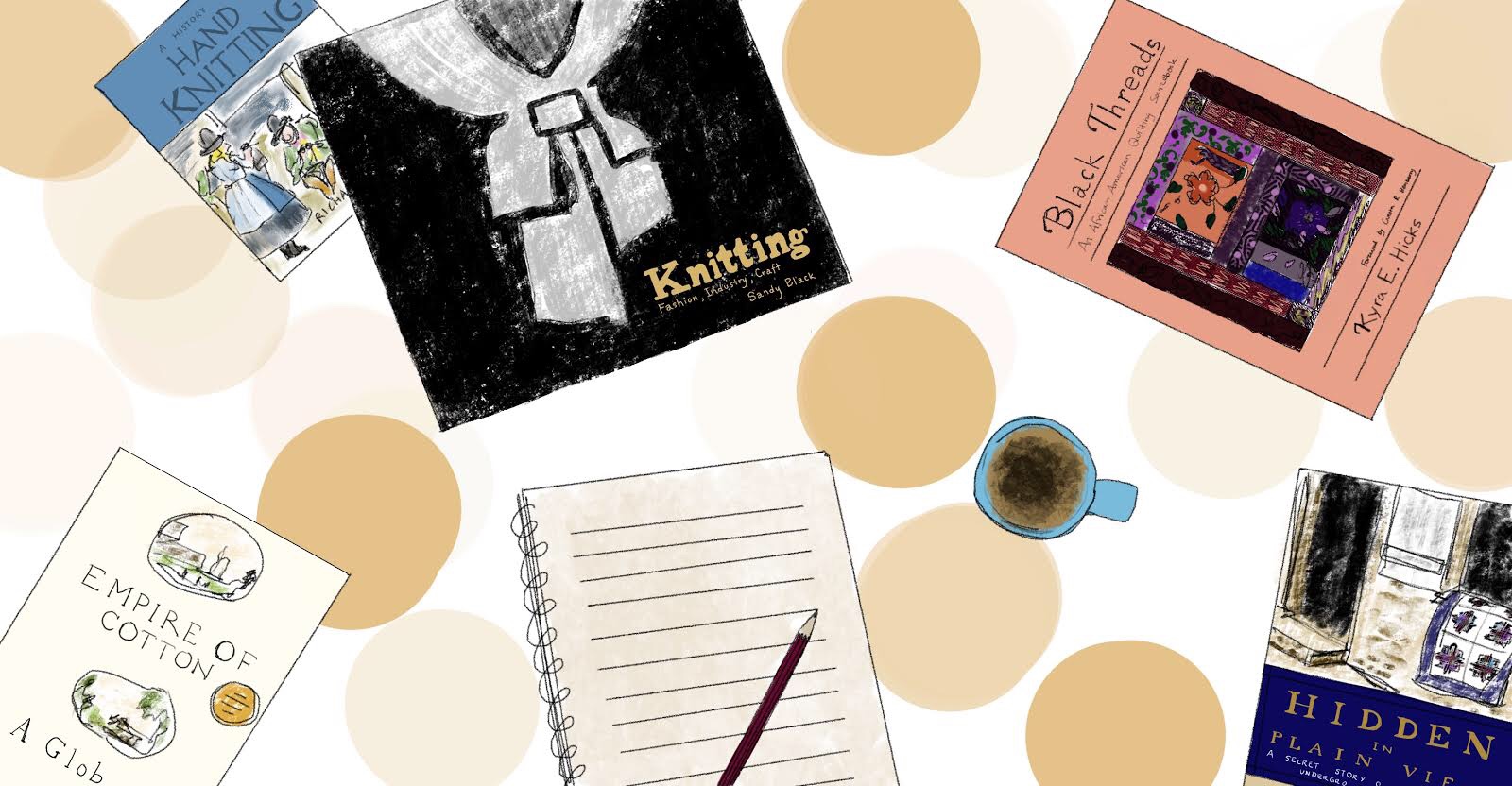
- A History of Hand Knitting by Richard Rutt
- Knitting: Fashion, Industry, Craft by Sandy Black
ASSIGNMENTS –
- Weekly – Once/week send out interesting post on Tides & Textiles IG account
- Twice/Month – Blog piece about what I have learned so far or dive into a particularly interesting topic within the content
- FINAL – TBD, based on findings… Could be an in-depth essay or a mixed media project
CLASS #3 – Cottons & Quilts: A Dive into Early African American Textiles
TEXTBOOKS-
- Empire of Cotton: A Global History by Sven Beckert
- Black Threads: An African American Quilting Sourcebook by Kyra Hicks
- Hidden in Plain View: A Secret Story of Quilts and the Underground Railroad by Jacqueline Tobin
ASSIGNMENTS –
- Weekly – Send out interesting post on Tides & Textiles IG account
- Twice/Month – Blog piece about what I have learned so far or dive into a particularly interesting topic within the content
- FINAL – TBD, based on findings
I believe a holistic education goes beyond simply book knowledge but can go deeper to reflect an education of the self. As the well-known Greek philosopher once put it…
“Knowing yourself is the beginning of all wisdom”
Aristotle
Or…
“We but mirror the world. All the tendencies present in the outer world are to be found in the world of our body. If we could change ourselves, the tendencies in the world would also change. As a man changes his own nature, so does the attitude of the world change towards him. This is the divine mystery supreme. A wonderful thing it is and the source of our happiness. We need not wait to see what others do.”
Mahatma Gandhi*
I hesitate to define self-education as being strictly about the things you bring into your mind from outside sources. Educating yourself is by nature self-guided and can grow and evolve as you do. It’s up to each of us to define our own style of and reason for learning. The process may end up being as much about knowing yourself and how to tune into your own intuition as it is about practical or interesting knowledge.

At the heart of this journey, the why is as important, if not more so, than the what. Reflect on why you are embarking on this journey but don’t hold too fast to one outcome or ideal, acknowledge those reasons as fluid.
And remember that learning won’t always be easy or comfortable. The satisfaction of it lies in the small wins. In taking back your time and your life from the mindless entertainment that corporations hope we overindulge in (i.e. online streaming services, video games, mindless scrolling). It takes determination to keep at it, to power through, to choose to read that book or write that article over watching another episode of that show. For accountability, I plan on crafting interesting updates on what I learned from my studies each week on this blog and through my Tides & Textiles Instagram (@tidesandtextiles).
So, there you have it, a call to hopefully inspire your own version of Academic Agency! I’ve listed some potentially useful articles, videos, books and organizations below to help you start your own learning journey. Also, if you are familiar with any of the above topics and can recommend resources, please let me know!
If you were to create your own class, what would you most like to learn about? How would you go about accomplishing it? What resources would you use?
If you have already done something similar, what did you learn? What was helpful in your journey?
ARTICLES/VIDEOS/BOOKS
Self-Education: Teach Yourself Anything with the Sandbox Method by Nat Eliason
Self-Education: The Key to Living the Life you Want by Chomwa Shikati
The DIY Degree: Using Self-Education To Earn A Bachelor’s Degree in 1 Year by Scott Young
Cheapest, Easiest DIY Master’s Degree by Will Gibbons
What is Open Education? (plus resources!)
DIY U: Pippa Buchanan’s Do-It-Yourself Master’s Degree by Anya Kamenetz
DIY U: The Future of Learning by Anya Kamenetz
The Personal MBA by Josh Kaufman
DIY U: Edupunks, Eupreneurs, and the Coming Transformation of Higher Education by Anya Kamenetz
ORGANIZATIONS
Skillshare – Skillshare is an American online learning community for people who want to learn from educational videos. The courses, which are not accredited, are available through subscription. The majority of courses focus on interaction rather than lecturing, with the primary goal of learning by completing a project.
Khan Academy – Khan Academy is an American non-profit educational organization created in 2008 by Salman Khan, with the goal of creating a set of online tools that help educate students. The organization produces short lessons in the form of videos.
OER Commons – OER Commons is a public digital library of open educational resources.
Peer-2-Peer University – Peer 2 Peer University is a nonprofit online open learning community which allows users to organize and participate in courses and study groups to learn about specific topics.
Coursera – Coursera is a world-wide online learning platform founded in 2012 by Stanford computer science professors Andrew Ng and Daphne Koller that offers massive open online courses, specializations, and degrees.
Masterclass – Masterclass is an American online education platform on which students can access tutorials and lectures pre-recorded by experts in various fields.
*Yes, I am aware some consider Gandhi a fallible figure at the moment but this is exactly why it is important to look holistically at history and to do your research!
 Tides & Textiles